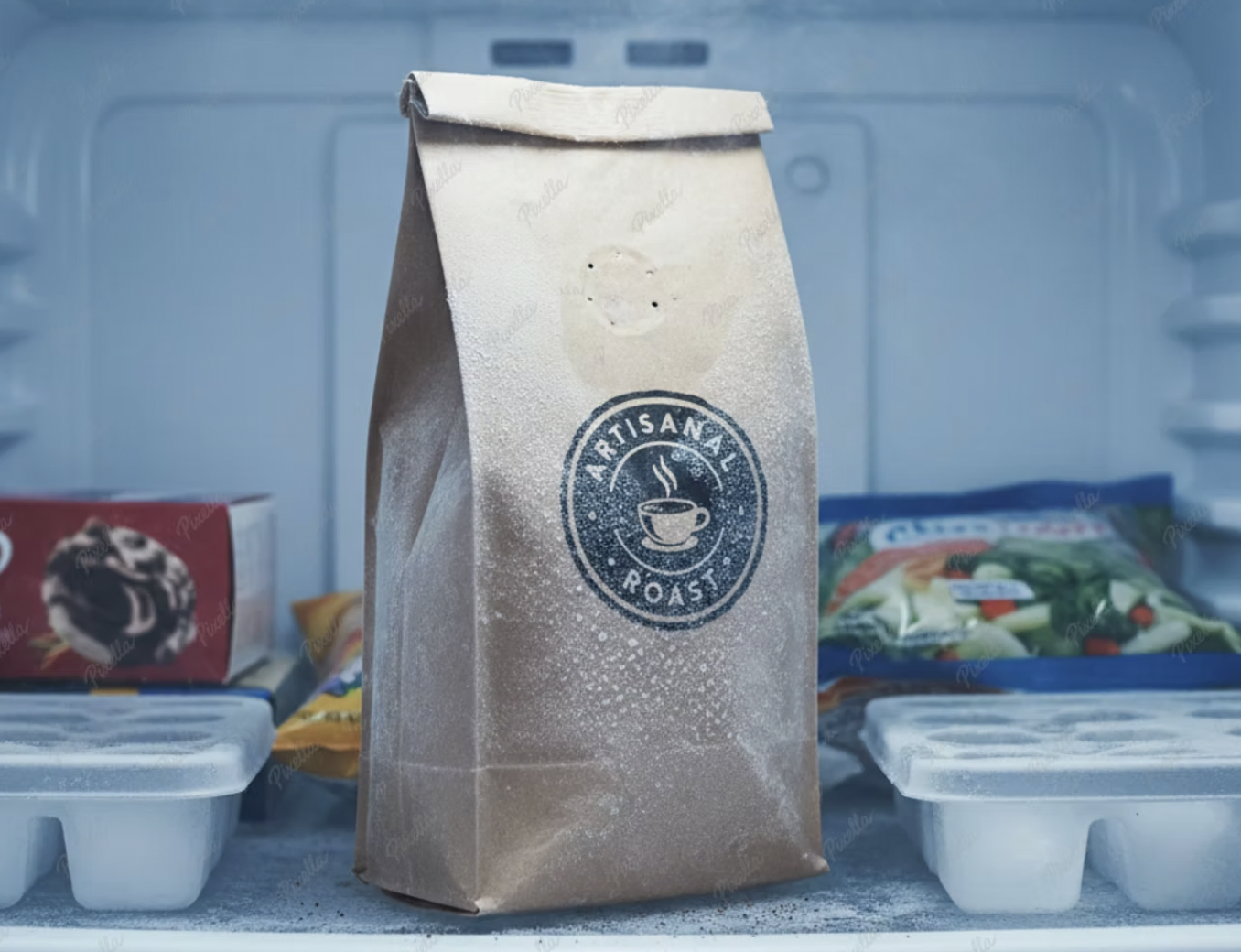
Should You Freeze Coffee Beans?
If your coffee has rested sufficiently after roasting and you’re saving some for future weeks or months, freezing is one of the best ways to preserve freshness.
For coffee you’ll use later, simply store the sealed bag in the freezer. The original packaging usually works well—just fold or roll the bag tightly to remove as much air as possible and tape over the one-way degassing valve as an extra precaution against odors. While these valves are designed to prevent air from entering, they can occasionally leak over long storage periods.
For rare or exceptional coffees that you want to preserve for many months, vacuum sealing before freezing provides even greater protection by removing most of the oxygen that drives staling.
Why Freezing Works
Roasted coffee beans contain only 2–3% moisture, so they don’t freeze solid like fruits or vegetables. Instead, freezing dramatically slows the chemical reactions responsible for coffee becoming stale, including oxidation, loss of aromatic compounds, and lipid oxidation (rancidity).
The Specialty Coffee Association (SCA) recommends protecting coffee from oxygen, heat, moisture, and light to preserve quality. Freezing, when done properly, addresses several of these factors at once.
An additional benefit is that frozen beans often grind more consistently. Because colder beans fracture more cleanly, many grinders produce fewer fine particles, resulting in a more uniform grind. The lower bean temperature may also slightly reduce heat generated during grinding.
Does Humidity Matter?
Most concerns about freezing coffee involve moisture, not temperature.
Moisture becomes a problem when coffee repeatedly warms and cools, allowing condensation to form on the beans. To avoid this:
- Store coffee in airtight packaging.
- Allow frozen coffee to warm while still sealed if thawing an entire bag.
- Avoid repeatedly exposing coffee to warm, humid air.
Many people portion coffee into single-dose or weekly bags before freezing. This works well, but it’s largely a convenience rather than a freshness requirement.
Personal Note
Unless you live in an unusually humid climate, quickly removing a bag from the freezer, weighing out enough beans for one brew, and immediately returning it is unlikely to cause problems. I’ve done this for years without noticing any decline in cup quality.
However, once a bag has completely thawed, don’t refreeze it. Repeated temperature cycling increases the chance of condensation and accelerates staling.
How Much Longer Does Frozen Coffee Last?
A useful rule of thumb borrowed from food science is that many chemical reactions slow by approximately half for every 10°C (18°F) decrease in temperature. While coffee doesn’t follow this perfectly, it provides a useful estimate.
A typical household freezer operates around −18°C to −20°C (0°F to −4°F), while room temperature is generally 20–25°C (68–77°F).
Under stable conditions, coffee stored in a freezer may age roughly four to eight times more slowly than coffee stored at room temperature. The exact rate depends on roast level, packaging quality, oxygen exposure, and how often the freezer temperature changes.
For more on preserving coffee quality, see the Specialty Coffee Association’s research resources and the National Coffee Association.

Vacuum Sealing Extends Freshness Even Further
Freezing slows the chemical reactions that cause coffee to stale, but oxygen remains the primary driver of oxidation.
Vacuum sealing removes most of that oxygen before freezing, making it one of the best long-term storage methods for rare, limited-release, or seasonal coffees you want to enjoy months later.
For coffee you’ll finish within 1–4 weeks of peak freshness, however, a tightly rolled original bag stored in a cool, dark place is generally all that’s needed.
Final Thoughts
Freezing isn’t just acceptable—it can be one of the best ways to preserve exceptional coffee when done correctly. Use airtight packaging, minimize oxygen exposure, avoid repeated thawing and refreezing, and your favorite coffees can remain vibrant far longer than they would sitting on the countertop.
Original post Feb 25, 2026